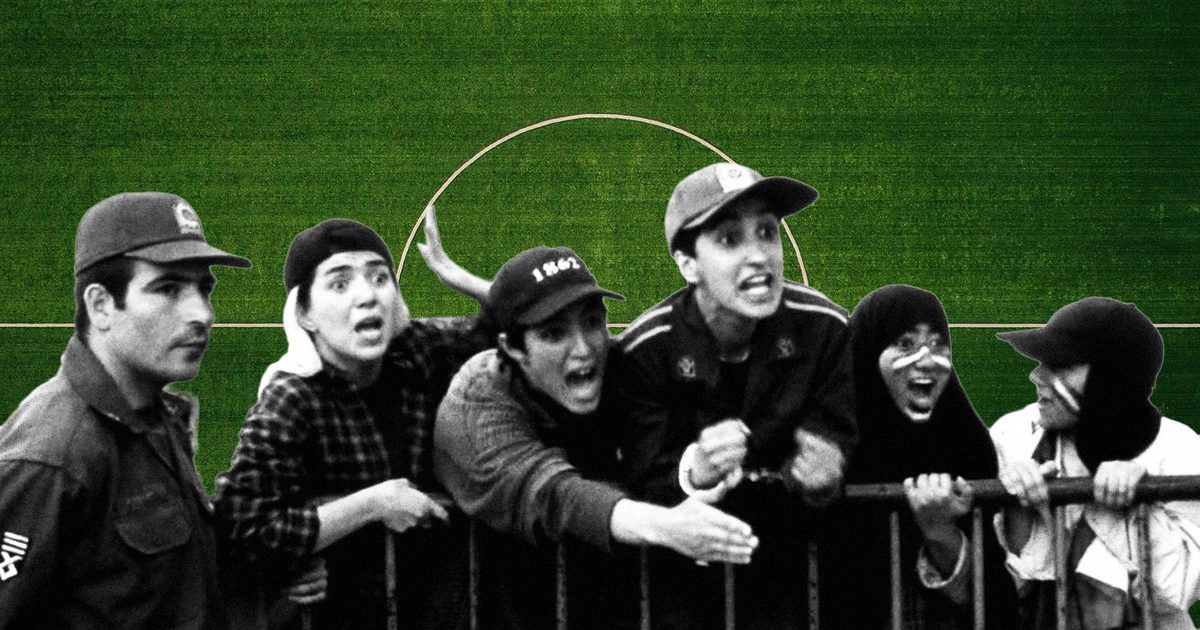
As she made her way inside, the first thing she noticed was the “hum”. “Because Iloved football, Iused to hear it from the television – this sound in the stadium,” Mobarakshahi says. “And when Iwent inside, it was the first thing [she noticed].” At half time, with the score still nil-nil, they left the ground and awaited the results in the streets, ready to record the reactions of fans on camera – whatever the result may have been. It meant the ending ofOffsidewas left up to chance (or rather, the 22 players on the pitch) allowing the crew to capture history as it was happening. Just three minutes into the second half,Mohammad Nosrati headed the ball into the back of Bahrain’s net, putting Iran in the lead and ultimately securing them the win. As the actors were immersed in the city’s celebrations for the film’s final scene, satire revealed truth, just as when Mobarakshahi sat in men’s clothes among the stands.
Back then, Mobarakshahi wasn’t aware of the risk she had taken. “The laws and their enforcement in Iran can be complicated and unpredictable,” she says. At one point during filming she was stopped by security. Panahi and the rest of the crew came over, seeing the commotion, and they were all taken into avan, and held for almost an hour. “At first, Iwas really frightened because Ihad no idea what was going to happen to us. But eventually, everything was resolved and we were allowed to leave,” she continues. “I think the fact that we had afilming permit helped us get out of that situation. Things might have turned out very differently under different circumstances.”
That film permit was another remarkable aspect ofOffside’s bold production. To get production for the film off the ground, the team submitted aproposal to Iran’s Ministry of Culture and Islamic Guidance for aless controversial script under the titleThe World Cup. The film’s co-writer, Shadmehr Rastin, says the fake application was made in his name, “so if anything had gone wrong, [I] would have been detained”.
Another big risk, one would think, but between puffs of his pipe, Rastin explains that at the time, he was not so concerned about the potential repercussions. If they had been caught, he expected atelling off – perhaps in “the worst case”, the authorities would confiscate anything they hadshot.
Besides, Panahi was at the helm of the project; afamed director who had built areputation in Iran for sociological storytelling and creating art that evaded censorship, so the team put their faith in him. Even in conversation, Rastin defers to Panahi when questioned. “Mr Panahi kept his team and his circle small,” he says. “[He] only worked with trusted people.”
SinceOffside, times have changed. Following his critically lauded filmIt Was Just An Accident,Panahi has been handed anew prison sentence, on top of his suspended sentence, and had his assets seized in Iran; Mobarakshahi has left the country and works as an actress in Belgium, and Rastin can only log on to social media every few weeks via aVPN amid the country’s internet blackouts – on one occasion to see this interview request waiting for him. The first thing he does? Contact Panahi to tell him. As Rastin tells it, the pair marvelled at the fact that 20years had passed, the anniversary until then had escaped their notice. This was just as Panahi had landed in Iran for his mother’s funeral, shortly before his 2025 prison sentence was upheld.
Meanwhile, change for Iran’s female football fans has been small, slow and inconsistent. In recent years, the death ofSahar Khodayari, an Iranian football fan who set herself on fire after being arrested for sneaking into astadium dressed as aman, made headlines and was met with international outrage. Khodayari, who had become known online as ‘Blue Girl’ after her favourite team Esteghlal’s colours, died in hospital of her injuries in 2019, 13years afterOffsidewas released.
In2022, Iran allowed alimited number of women to watch the World Cup qualifying match against Iraq, once again held in Tehran’s Azadi stadium, yet only two months later, despite having tickets, women were blocked by police from entering the World Cup qualifier against Lebanon andpepper sprayed. In2023, women were allowed into Azadi to watch the Tehran derby, but they were limited to 3,000 tickets, and given seats with poor vantage points.
Rastin hopes to see real gains for women’s rights within Iranian football. He recalls the initial response toOffsidefrom his industry peers – while they conceded that the film was good, they concluded it was “gimmicky”. Rastin was told the film had ashelf life; that the restrictions on women, barring them from football stadiums, would be lifted. It was only amatter of time. “And 20years later, still, women cannot go to the stadium easily. So the film still resonates,” heretorts. “Every time Isee them, Itell them, ‘Okay, when is the expiry datedue?’”
Mobarakshahi hopes one day audiences will watchOffsideand be surprised such restrictions ever existed, but for now, she says gravely, “that moment has not arrived.”
Read the original article here